
Building a new metro line in a major European city is about much more than engineering. It also requires finding solutions that allow construction to progress without completely disrupting road traffic, public transport, and the daily lives of residents.
One such solution is the Top-Down construction method, one of the most efficient technologies currently used for building tunnels and underground stations in densely populated urban environments.
The extension of Munich’s U5 metro line, one of the city’s largest ongoing infrastructure investments, is a prime example of this approach. The Top-Down method is being used to construct several underground sections and stations, and the RCBB team is contributing to the execution of the works alongside its project partners.
What is the Top-Down construction method?
In conventional underground construction, the site is first excavated to its final depth before the permanent structure is built.
The Top-Down method completely reverses this sequence.
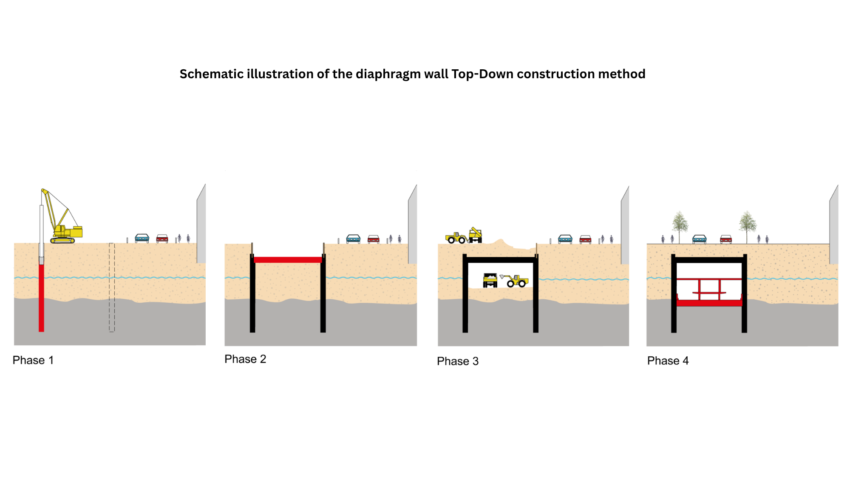
Instead of building from the bottom up, the structure is constructed from the top down. Permanent retaining walls and the top concrete slab are built first. Excavation then continues beneath this slab while traffic and surface activities can gradually resume above.
In practice, the city continues to function while construction progresses underground.
How does the construction process work?
The process begins with the construction of the perimeter walls for the future station or tunnel. Depending on the geotechnical conditions, these are built either as diaphragm walls or bored pile walls, both of which become part of the permanent structure.
Once the retaining walls are completed, the top concrete slab—commonly referred to as the deck—is cast.
After the slab reaches the required strength, road traffic, public transport and pedestrian access can be restored while construction continues below street level.
Excavation is carried out through specially designed openings in the slab. As the work progresses, intermediate slabs, internal walls and finally the foundation slab are constructed.
The result is an underground structure built almost entirely beneath the protection of the top slab, with minimal impact on the surface.
Why is the Top-Down method preferred in major cities?
The Top-Down construction method is particularly suitable for densely populated urban areas where closing roads and transport routes for several years would have significant economic and social consequences.
Compared to traditional open excavation, this technology offers several important advantages.
It significantly reduces the time roads are occupied by construction works, allows road traffic and, in many cases, public transport services to continue operating, minimizes noise and inconvenience for nearby residents, limits ground movements that could affect neighbouring buildings, and enables multiple construction activities to take place simultaneously.
For these reasons, the Top-Down method has been adopted in major infrastructure projects in cities such as London, Paris, Singapore, Hong Kong and Doha.
How is it being used in the U5 Munich extension?
The extension of the U5 metro line towards Pasing is one of Germany’s most significant urban infrastructure projects currently under construction.
Along several sections of the route, engineers are using Schlitzwand-Deckelbauweise, the German version of the Top-Down method based on diaphragm walls. These walls are constructed to depths of approximately 30 metres and form the permanent walls of the future underground stations. A reinforced concrete deck, approximately two metres thick, is then cast above them, allowing traffic to return while excavation continues underneath.
At the future Am Knie station, a different variation, Bohrpfahl-Deckelbauweise, based on bored pile walls, is being used. This solution was selected because the distance between street level and the future underground structure is too small for conventional construction methods.
Using this approach, work can continue for several years without completely closing one of Munich’s busiest transport corridors.
A technology that is changing the way we build cities
As cities continue to grow and existing infrastructure needs to be expanded without disrupting urban life, construction methods such as Top-Down are becoming increasingly important.
They demonstrate that complex infrastructure projects are about much more than concrete, reinforcement and heavy equipment. They rely on innovative engineering solutions that minimize disruption for local communities while allowing cities to continue functioning throughout construction.
Through its involvement in the U5 Munich extension, RCBB is contributing to a project that will connect new districts of the city and improve mobility for tens of thousands of passengers every day.
For our team, it is another opportunity to help deliver modern infrastructure while applying some of today’s most advanced construction technologies.