
Germany is no longer transitioning to green energy; it is already in full execution mode. Renewables now generate over 50% of the country’s electricity, with wind energy as the leading source. The national target is even more ambitious: 80% renewable electricity by 2030.
In practice, this means:
- continuous expansion of onshore wind farms
- larger and more powerful turbines
- shorter delivery timelines
- increasing pressure across the supply chain
Wind energy already accounts for roughly a quarter of electricity demand, and capacity continues to grow each year. This is not a theoretical market — it is one of the most active construction environments in Europe.
And the key point is clear: none of this growth happens without construction capacity.
A second challenge: replacing the first generation of wind farms
Alongside new developments, Germany faces another major challenge: renewing its existing wind fleet.
Many turbines installed in the early 2000s are reaching the end of their lifecycle or are no longer economically viable. Instead of maintaining them, operators increasingly choose repowering — replacing older turbines with fewer, more efficient, and more powerful units.
This process involves:
- dismantling existing structures
- redesigning foundations
- building new structures adapted to larger turbines
The result is significantly higher energy output on the same site.
Where construction becomes critical
Behind every turbine lies a substantial amount of unseen work.
Before energy production begins, there is:
- ground preparation
- foundation engineering
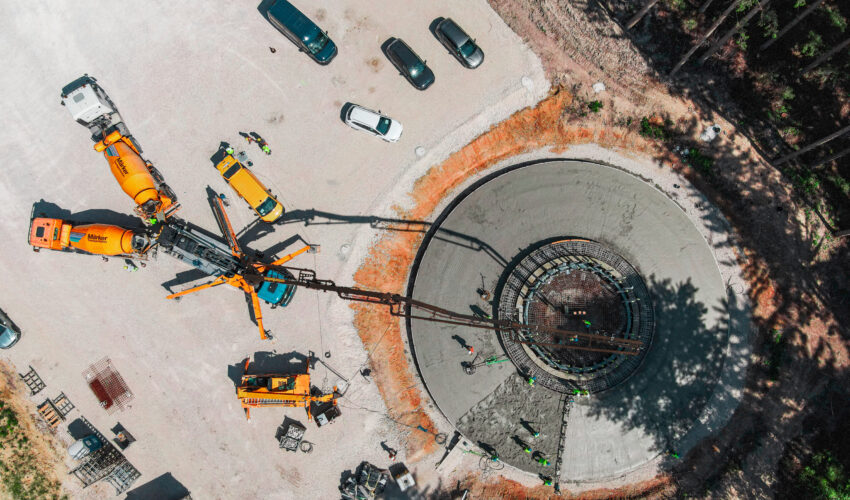
- large-scale concrete works
- high-precision structural execution
Modern turbines reach heights of up to 280 meters, with rotors exceeding 200 meters — pushing construction to its limits.
Each foundation requires:
- large volumes of concrete
- hundreds of tons of reinforcement
- strict execution tolerances
If the foundation fails, the entire asset is at risk.
Our role in this ecosystem
Over the past year, RCBB Gruppe has been involved in wind energy projects in Germany, in partnership with Max Bögl.
- Phase 1: 5 foundations completed near Münster (Augsburg)
- Phase 2: 8 foundations delivered in Blankenhain under tight timelines
- Phase 3: starting in the second half of April
Our role is clear: delivering the structural base that everything else depends on.
What partners actually need
In theory, everyone wants innovation.
In reality, execution is what matters.
Partners are looking for:
- predictability
- adherence to deadlines
- international standards
- seamless integration into complex projects
In renewable energy, delays don’t just cost money; they delay energy production.
Green energy doesn’t scale through strategies. It scales through consistent execution, under pressure, and at scale. That’s where we position ourselves.