
Sustainable construction is often associated with low-carbon materials, energy-efficient buildings, renewable energy and new technologies. All of these are important. Yet another important part of sustainability begins much closer to everyday construction operations: using existing resources responsibly and preventing materials from becoming waste in the first place.
The scale of the challenge is significant. Construction and demolition waste accounts for more than one third of all waste generated in the European Union. It includes concrete, bricks, wood, glass, metals, plastics and other materials generated through construction and demolition activities.
Globally, the wider impact of the built environment is equally relevant. According to the UNEP Global Status Report for Buildings and Construction 2024–2025, buildings account for approximately 32% of global energy use and contribute around 34% of global CO₂ emissions.
Against this background, sustainable construction cannot begin only when waste reaches the recycling container.
It needs to start before waste is created.
Waste prevention before recycling
A circular approach to construction increasingly focuses on extending the useful life of materials, reuse and waste prevention.
Although construction and demolition materials have relatively high recovery rates in many parts of Europe, the European Environment Agency points out that much of this recovery still involves lower-value applications such as backfilling and recycled aggregates used in road sub-bases.
A more circular construction sector therefore requires greater emphasis on preventing waste, reusing materials and keeping resources in circulation at their highest possible value.
On a construction site, this translates into very practical decisions.
Accurate planning can prevent unnecessary surplus materials. Correct storage protects materials from damage. Careful handling extends the useful life of equipment. Timely cleaning and maintenance make it possible to reuse formwork systems and other construction components for longer.
Each action may appear relatively small. Repeated every day across multiple projects, however, their combined impact becomes significant.
“ZERO LOSSES, AVOID WASTE” – putting sustainability into practice at RCBB
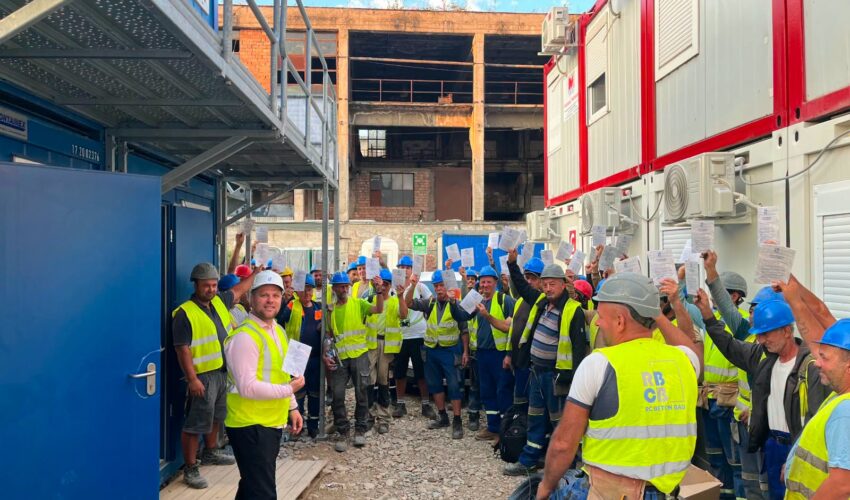
Based on this approach, RCBB launched its internal “ZERO PIERDERI, EVITĂ RISIPA” – “Zero Losses, Avoid Waste” campaign across its construction sites in Romania.
The initiative focused particularly on the responsible use of formwork and scaffolding systems.
Site teams received a practical guide explaining how equipment should be used, handled, stored, cleaned and returned.
The objective was straightforward: correct use of formwork and scaffolding can reduce repair and cleaning costs, decrease the number of lost or damaged components, optimise transportation and contribute to safer and more productive construction sites.
From formwork to better site management
Reusable formwork systems are a clear example of why everyday construction practices matter.
Beams, for instance, should be used at their standard lengths instead of being unnecessarily shortened for individual site requirements. Props also need to be removed using the correct procedure rather than being struck or allowed to fall, which can deform and damage them.
Handling is equally important. Formwork panels should be moved using the appropriate lifting devices, while stripping should be carried out carefully with the correct tools to avoid damage to frames and surfaces.
Storage also plays a role. Panels should be kept off the ground on suitable supports, while smaller components should be organised and transported in dedicated containers rather than left exposed to damage or loss.
Maintenance completes the cycle.
Removing concrete residue immediately after pouring prevents it from hardening on formwork panels. Cleaning beams, frames, and scaffolding before they are returned can prevent unnecessary cleaning work and associated costs.
Behind all these measures is a simple principle:
A material that is protected and reused is a material that does not need to be replaced.
Sustainable construction also depends on people
Processes and equipment alone are not enough.
Sustainable site practices depend on the people applying them every day.
For this reason, the RCBB campaign was designed not only as an information initiative but also as a way to involve our colleagues directly.
Each campaign brochure included an individual number for a prize draw, encouraging employees to keep the material available for future reference. Employees who kept their brochures and were able to correctly answer questions based on the information they contained had the opportunity to win prizes.
It was a simple way of turning information into engagement and reinforcing the practices presented during the campaign.
The final message of the guide summarises the approach clearly: keeping a construction site clean and organised helps prevent both damage and losses while also contributing to a safer working environment. Brosura SSM – ZERO Pierderi, Evita risipa.pdfPDF
Less waste also means more efficient construction
Reducing waste is not exclusively an environmental objective.
It is also an operational one.
A damaged component has to be replaced. A lost part has to be purchased again. Equipment returned in poor condition may require additional cleaning or repairs. Incorrect material planning can create surplus stock, additional transportation and unnecessary costs.
From this perspective, sustainability and economic efficiency are often working towards the same goal.
For RCBB, responsible construction also means paying attention to these everyday decisions.
Use materials correctly. Protect what can be reused. Prevent losses before they become waste.
Because sustainable construction is also built through small decisions made well, every day.
Less waste. More responsibility.