
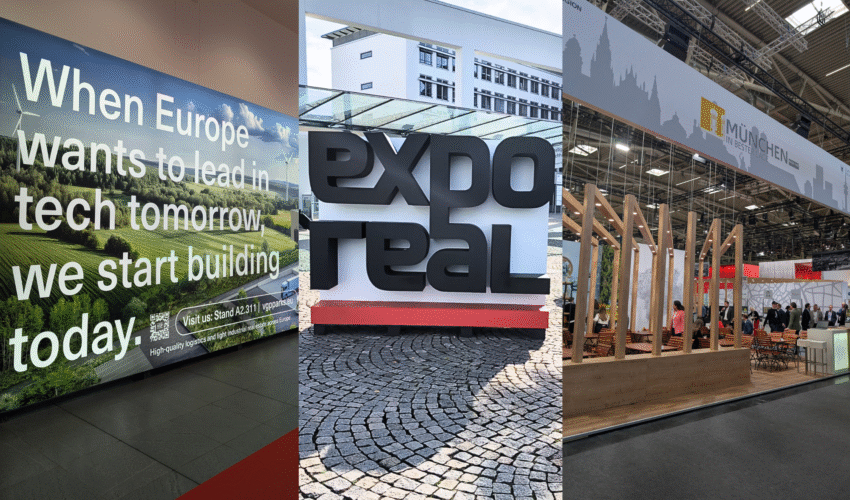
The RCBB team was at EXPO REAL today—the most important B2B platform for Europe’s real estate industry. Three days of intense dialogue, concrete projects, and many meaningful meetings with developers, investors, cities, and regions. The mood? One of cautious yet determined recovery: the sector is starting to breathe again, and conversations are increasingly moving from problems to solutions.
- What is EXPO REAL? A major B2B trade fair for real estate investment and development, held annually at Messe München.
- What was the dominant theme in 2025? Affordable housing, with an emphasis on practical solutions and blended public–private financing.
- Why did RCBB attend? To engage with partners, validate trends, and map relevant opportunities across the European market.
What is EXPO REAL and why does it matter
EXPO REAL brings the entire lifecycle of a real estate project together in one place—from conception and financing to execution, operation, and use—through a conference program spanning nine dedicated forums and hundreds of speakers. This year, the official focus fell on Residential, Logistics, Retail, and Hospitality, as well as the innovation area “Transform & Beyond,” where digitalization, decarbonization, and new business models are presented in a hands-on way.
Theme of the year: affordable housing with a European lens
“Affordable housing” dominated the program—from the “Flexible Housing” forum to the launch of the “EXPO REAL Housing Study powered by Pestel Institute,” presented on day one. The European dimension is clear: Eamon Ryan, Chair of the European Commission’s Housing Advisory Board, took part in discussions about solutions and mixed public–private financing in the context of the forthcoming European Affordable Housing Plan.
Why the market is under pressure: the big numbers behind the debate
Recent studies confirm the gap between need and delivery: Germany requires roughly 320,000 new homes annually until 2030, while in 2024 only about 216,000 building permits were issued—the slowest pace since 2010. It’s not just a social issue: the housing shortfall directly weighs on the labor market and economic growth, which is why the topic took priority at the Munich event.
What solutions were discussed at the fair
On the regulatory side, the emphasis is on accelerating approvals via the so-called “Bau-Turbo” proposed by German authorities, and on simplifying standards through “Gebäudetyp E” (Construction Type E)—a framework enabling faster, more affordable projects while meeting safety requirements. In parallel, serial and modular construction returned to the forefront as levers to reduce costs and shorten timelines.
Transform & Beyond: where innovation meets decarbonization
The “Transform & Beyond” area brought together tech providers, startups, and established companies around pressing themes: reducing the carbon footprint, digital business models, and data for planning and operations. It proved to be the place where “ready-to-deploy” solutions are one step from market, with discussions that can quickly move from concept to pilot.
RCBB at EXPO REAL 2025: observations from Europe’s real estate market
The dominant sentiment at the event remained one of cautious optimism: interest rates and bureaucracy are still major challenges, but the market is gradually stabilizing and major players are returning to the investment table. For us, EXPO REAL provided exactly the fuel we needed: industry-validated ideas, new contacts, and confirmation that the future of construction must prioritize efficiency, digitalization, and affordable-housing solutions aligned with current environmental needs.
Openness toward cities and regions was visible across all halls. Public-sector representatives came with clear portfolios for conversions, refurbishments, and urban infill, accompanied by discussions on faster permitting and simplified standards. In this context, affordable housing was not treated in isolation, but as part of an urban strategy that combines mobility, mixed use, and energy efficiency.
In the innovation area, the focus fell on data interoperability and solutions that connect design, planning, and operations. Modeling, monitoring, and intelligent analytics were presented not as ends in themselves, but as tools to reduce uncertainty, improve decisions, and support decarbonization goals. The overall impression: the shift from “pilot” to routine use is accelerating.
The conclusion of these days is straightforward: the market is redefining its priorities around feasibility, quality, and effective collaboration.