
The construction industry plays an essential role in developing communities, but it also carries a significant environmental responsibility. Globally, the buildings and construction sector accounts for approximately 37% of carbon emissions, while in the European Union, construction activities generate more than 38% of total waste.
These figures show that sustainability in construction can no longer be measured solely by the energy efficiency of completed buildings. How we build matters just as much: how much concrete we use, how much reinforcement steel we install, how much material goes to waste, how we manage construction waste, and how efficiently we use resources on site.
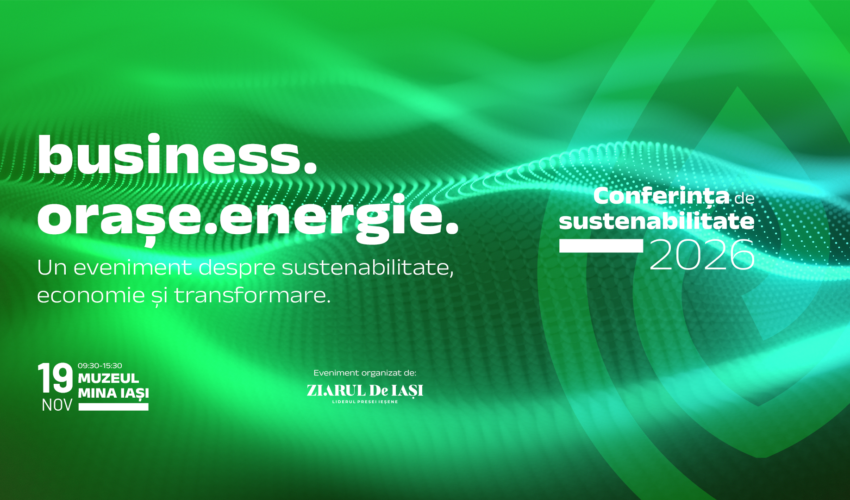
With this in mind, on November 19, RCBB will participate as a Green Leader Partner in the .De Sustenabilitate Conference, organised by Ziarul de Iași, at the MINA Museum in Iași, Romania. Under the theme “Business. Cities. Energy.”, the event will bring together business leaders, sustainability experts, and public authorities to explore how companies can become more sustainable while remaining competitive, how cities can develop more responsibly, and how energy efficiency and ESG principles can shape future investments. Through panel discussions, practical examples, and immersive experiences, including EY’s Four Futures exploration of possible scenarios for 2055, the conference aims to encourage dialogue and inspire solutions for a more sustainable future.
Sustainability in construction is far from simple. It is a complex challenge that requires careful planning at every stage, the right resources, financial investment, and, above all, people who understand and embrace the need for change. Perhaps the greatest challenge is the human factor: changing habits, encouraging responsibility, and turning sustainability into everyday practice on construction sites.
At RCBB, our goal is to turn these challenges into concrete actions. One of the projects through which we are developing this approach is our construction site in Păun, Iași County, Romania, where we are preparing the implementation of a pilot programme focused on monitoring and reducing material waste.
Our objective is to measure material losses, associated costs, and environmental impact, including CO₂ emissions, to identify optimisation opportunities that could later be implemented across other RCBB construction sites. And our direction is clear: less waste, more responsible resource consumption, and more efficient construction processes.
At the same time, through our involvement in renewable energy infrastructure projects, including the construction of wind turbine foundations in Germany, we contribute to the expansion of renewable energy generation capacity.
We are joining the conference next week not only to share our perspective, but also to listen, learn, and exchange ideas with professionals from different industries. We hope to leave with fresh insights, practical solutions, and new perspectives that can help us make our construction processes more sustainable. We believe that meaningful progress starts with open dialogue, a willingness to learn, and the ambition to turn ideas into concrete actions.
For us, building green is not a separate objective from our construction activities. It is a direction we aim to increasingly integrate into the way we plan, organise, and execute our projects. Because building responsibly is not only about what we leave behind, but also about the resources we consume along the way.