
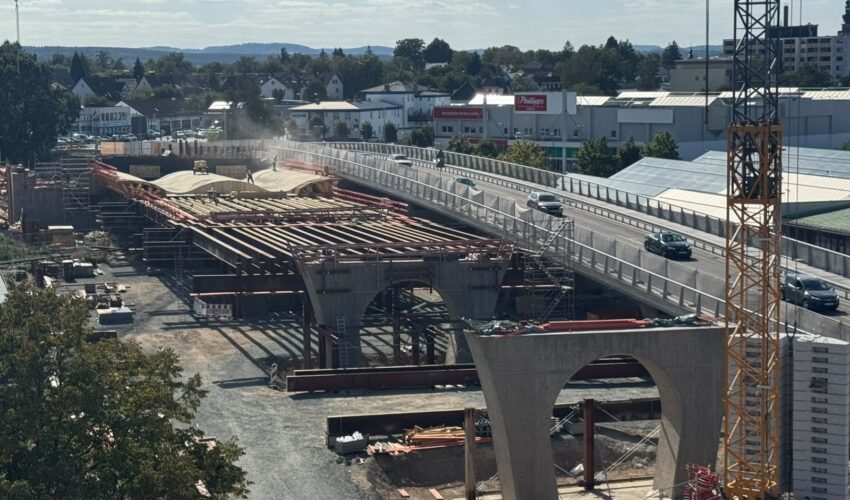
RCBB Gruppe is contributing to the construction of the new Hochbrücke Bayreuth, a major infrastructure project in Bavaria, Germany. With an investment of approximately €105 million and a length of more than 560 metres, the new bridge will become both an important transport connection and a distinctive structure at one of the main gateways into Bayreuth.
RCBB Gruppe has been working on the project together with Max Bögl since April 2026. RCBB’s scope includes the construction of two ramps and the main bridge structure.
The Hochbrücke Bayreuth is a good example of the complexity of modern bridge construction and infrastructure engineering: an unusual geometry, two different structural systems and construction taking place in an area crossed by the A9 motorway, railway infrastructure, a local road and a cycle path.
Why does the Hochbrücke Bayreuth look like a wave?
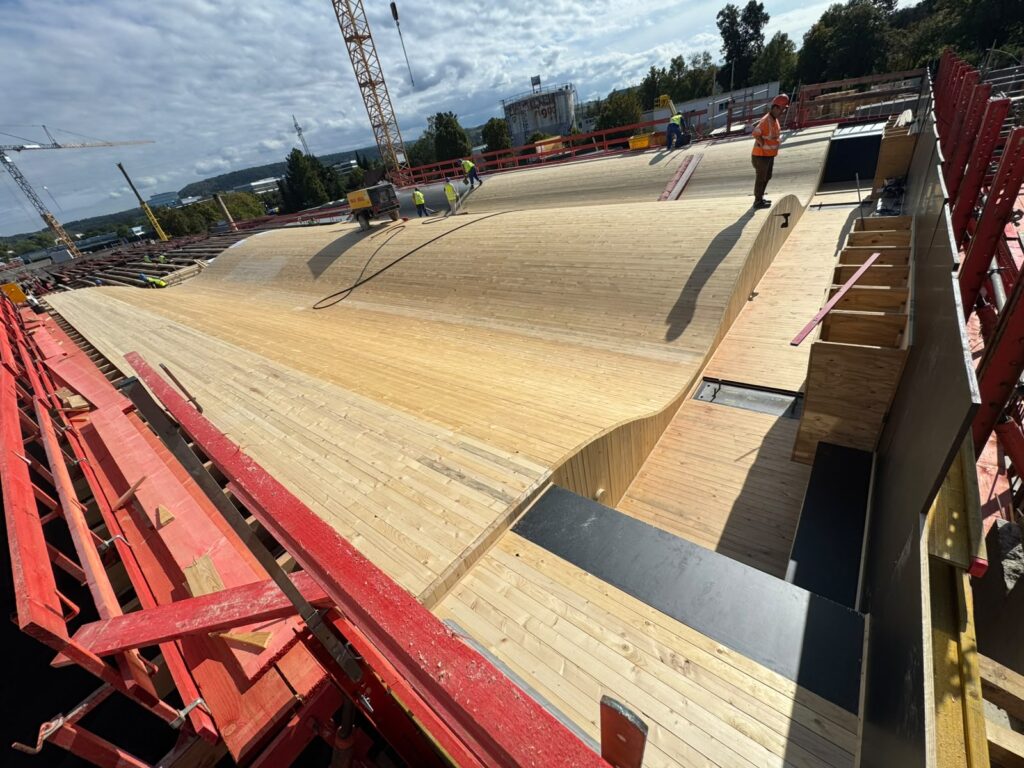
The most distinctive feature of the new bridge is its wave-shaped superstructure.
The B2 is one of the main gateways into Bayreuth, which meant that the architectural appearance of the new structure was an important consideration during the planning process.
The wave is therefore more than a visual feature added to a conventional bridge. Its geometry is part of the overall structural and architectural concept.
The design creates a balanced relationship between the spans, superstructure and piers. The shape of the piers also picks up the curvature of the superstructure, creating a consistent architectural language across the bridge.
Official planning documentation shows that a total of seven design alternatives were discussed, with three developed in greater detail.
The final solution had to balance structural requirements, complex site conditions and the bridge’s relationship with the surrounding urban environment.
The result is a structure in which civil engineering and architectural design work together.
One bridge, two structural systems
Another interesting feature of the Hochbrücke Bayreuth is the combination of two different structural solutions.
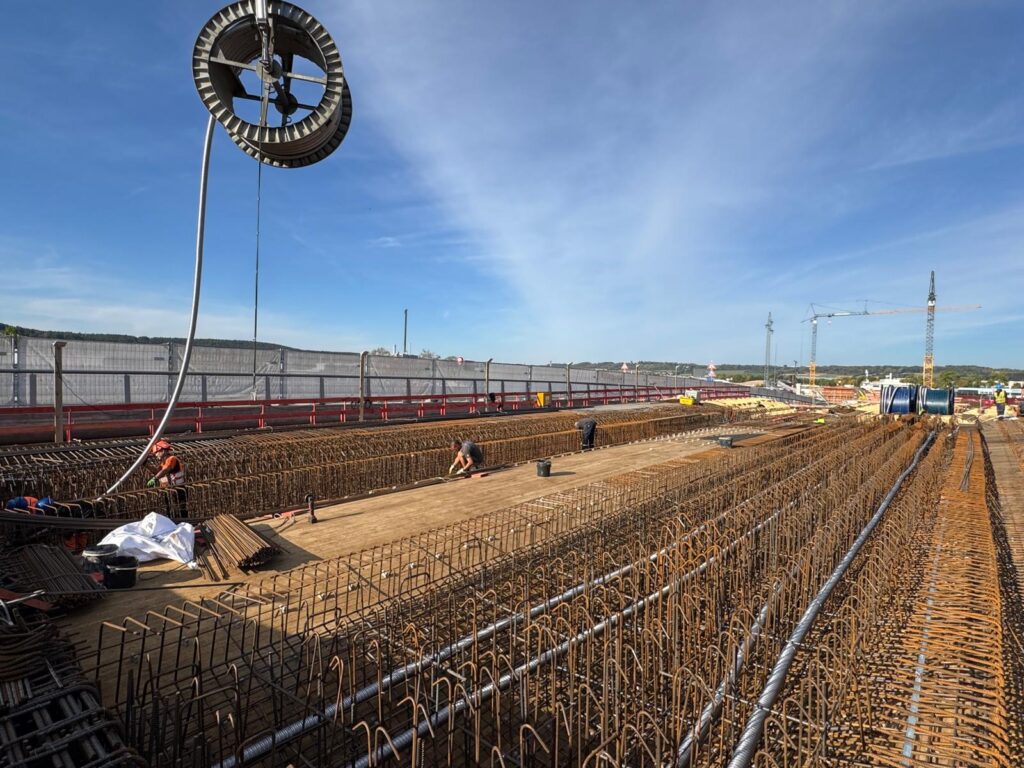
Across most of the bridge, the wave-shaped superstructure is constructed using post-tensioned concrete.
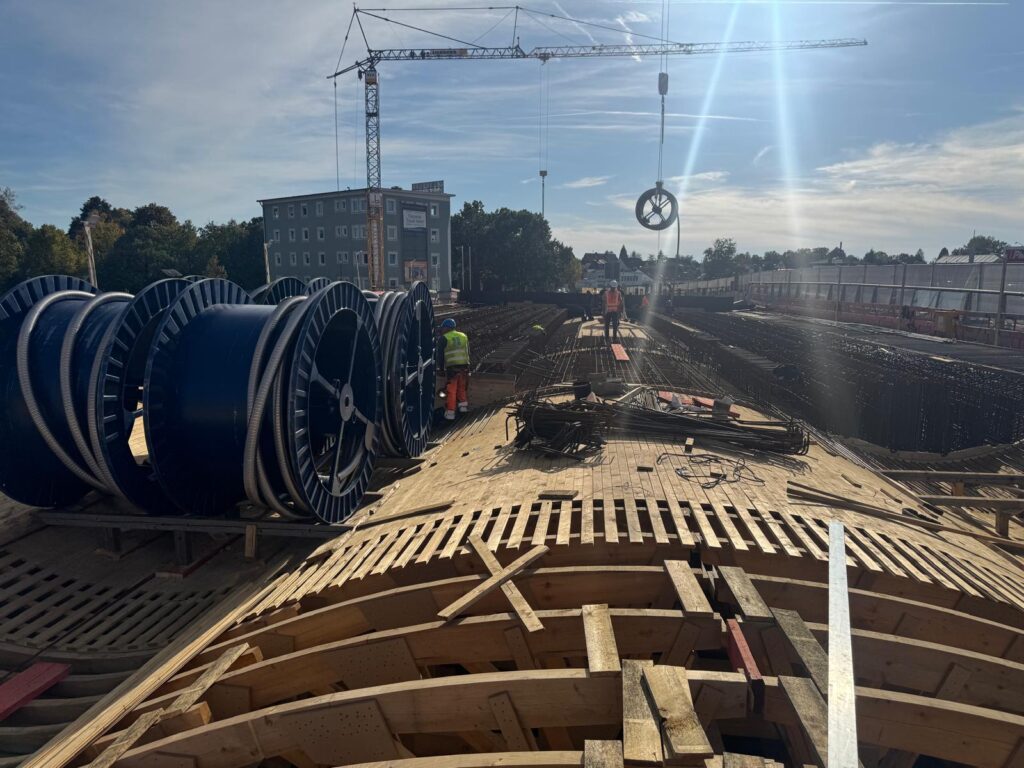
High-strength steel tendons are tensioned to introduce compression into the concrete. This makes it possible to achieve longer spans and more slender structural elements while controlling tensile stresses, cracking and deformation.
However, the conditions change where the bridge crosses the A9 motorway.
Here, a steel-concrete composite structure is used. Steel and concrete are structurally connected so that both materials work together as a single structural system.
Using different construction methods within the same bridge illustrates a fundamental principle of modern infrastructure engineering:
Different conditions require different engineering solutions.
How do you build a bridge over a live motorway?
Designing the structure is only one part of the challenge. The next challenge is building it while the infrastructure below remains in use.
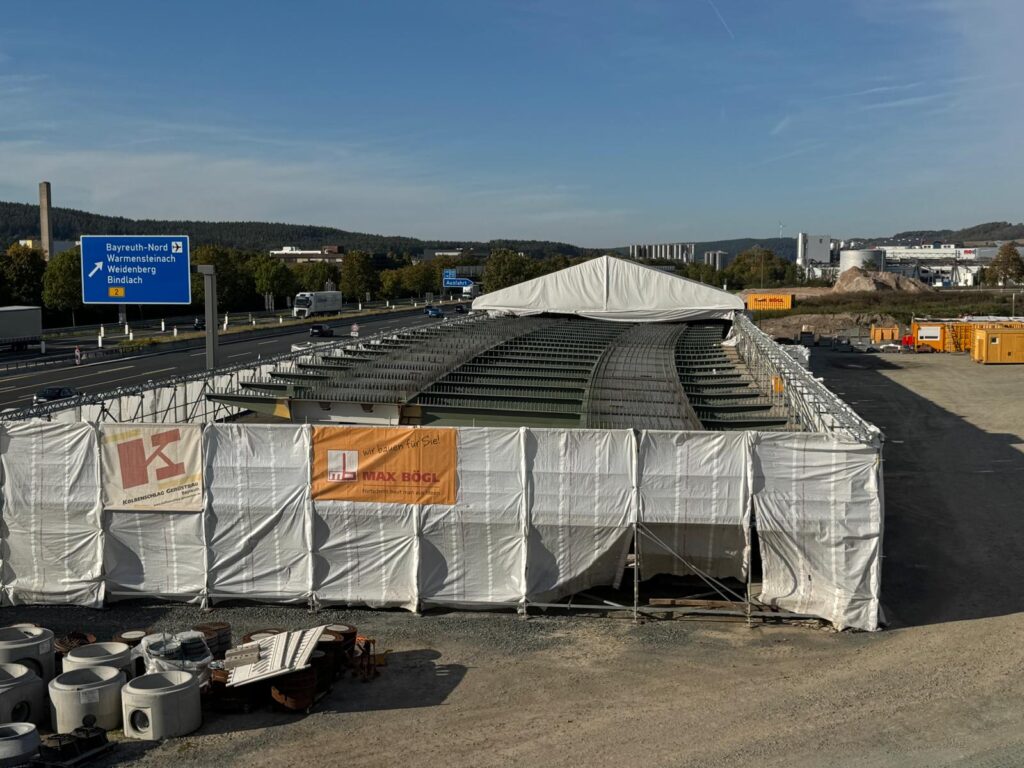
For the section crossing the A9, the steel superstructure is assembled and welded in a temporary fabrication area next to the motorway.
The structure can then be moved into its final position above the A9.
Meanwhile, the wave-shaped post-tensioned concrete sections are constructed using temporary supporting structures.
The construction sequence is designed around the existing transport infrastructure, allowing work to progress while limiting disruption to traffic.
This is one of the key differences between constructing a structure on an unrestricted site and delivering a major transport infrastructure project within an existing road and rail network.
More than 560 metres of infrastructure in a complex environment
The new Hochbrücke Bayreuth carries the B2 across several existing transport routes and infrastructure elements, including the A9 motorway, railway infrastructure, Sophian-Kolb-Straße and a cycle path.
Each crossing creates its own requirements in terms of geometry, support positions, construction logistics, safety and sequencing.
For major bridge, road and tunnel construction projects, the physical construction is only one part of the challenge.
Construction planning, logistics, site access, temporary works and coordination with infrastructure that must remain operational are equally important.
This combination of structural engineering and construction logistics is what makes major infrastructure projects particularly demanding.
RCBB Gruppe and infrastructure construction in Germany
Hochbrücke Bayreuth represents another step in the continued development of RCBB Gruppe’s activities in complex infrastructure projects in Germany.
Our experience in reinforced concrete construction, formwork, reinforcement and concrete works provides a strong foundation for delivering technically demanding civil engineering structures.
Since April 2026, RCBB Gruppe has been working on the Hochbrücke Bayreuth project together with Max Bögl, with our scope covering two ramps and the main bridge structure.
Our teams in Germany are also involved in other complex transport and infrastructure projects.
These include work on the U5 extension in Munich, where new underground transport infrastructure is being constructed, as well as road and bridge projects in different regions of Germany.
This experience allows RCBB Gruppe to combine its expertise in concrete construction with the specific requirements of large-scale bridge construction, road infrastructure and underground infrastructure projects.
Concrete construction as a foundation for complex civil engineering
Large infrastructure projects differ significantly from conventional building construction.
The dimensions are larger, construction sequences are more complex and interaction with existing infrastructure creates additional technical and logistical requirements.
At the same time, many fundamental construction skills remain essential.
Complex bridge structures require precise formwork, accurately installed reinforcement, controlled concrete placement and close coordination between engineering, site management and construction teams.
Projects with demanding geometries, such as the wave-shaped Hochbrücke Bayreuth, demonstrate the importance of experience in concrete and reinforced concrete construction for modern civil engineering.
For RCBB Gruppe, this expertise provides a foundation for the continued expansion of our infrastructure activities in Germany.
From engineering plans to a real structure
Long before a bridge of this scale becomes visible on site, years of planning have already taken place.
Design alternatives, structural calculations, construction sequencing and technical solutions must eventually be transformed into a physical structure.
This is where construction begins.
For our teams, it means translating engineering drawings and technical plans into built structures while respecting the geometry, technical specifications and construction sequence of the project.
Today, Hochbrücke Bayreuth is a construction site.
Once completed, it will become part of Bayreuth’s transport infrastructure and urban landscape for decades to come.
Overall completion of the project is planned for 2028.
Today, a construction site. Tomorrow, part of Bayreuth’s landscape. Read also: WHY WILL THIS 105M GERMAN BRIDGE LOOK LIKE A WAVE